Why Choose a 7.4V Lithium Ion Battery Pack?
Choosing a 7.4v Lithium Ion Battery Pack can suit devices that need more voltage than one cell can provide. It typically connects two lithium-ion cells in series, giving a nominal voltage of 7.4 volts. Fully charged, a standard pack may reach 8.4 volts, so the device must tolerate that level. This matters in handheld instruments, portable speakers, and compact robotics, where space and weight are limited. Battery educator Isidor Buchmann of Cadex Electronics describes lithium-ion as “a low-maintenance system.” That is useful context, not a promise of zero upkeep.
The right choice depends on more than voltage. Check the device’s current draw, connector, dimensions, charging method, and required runtime. A small pack may fit neatly behind a plastic housing yet struggle under a motor’s startup load. A well-designed battery management system can help protect cells from unsafe operating conditions, but pack quality and proper charging still matter. Look for clear capacity ratings, temperature guidance, and manufacturer documentation. The label alone is not enough. One practical complication is that two packs with identical voltage can perform very differently under load. This introduction sets up a closer look at the 7.4v Lithium Ion Battery Pack’s benefits, trade-offs, and selection criteria—because a convenient voltage is only useful when the whole pack matches the device.
What a 7.4V Lithium-Ion Battery Pack Is
Why Choose a 7.4V Lithium Ion Battery Pack?
What a 7.4V Lithium-Ion Battery Pack Is
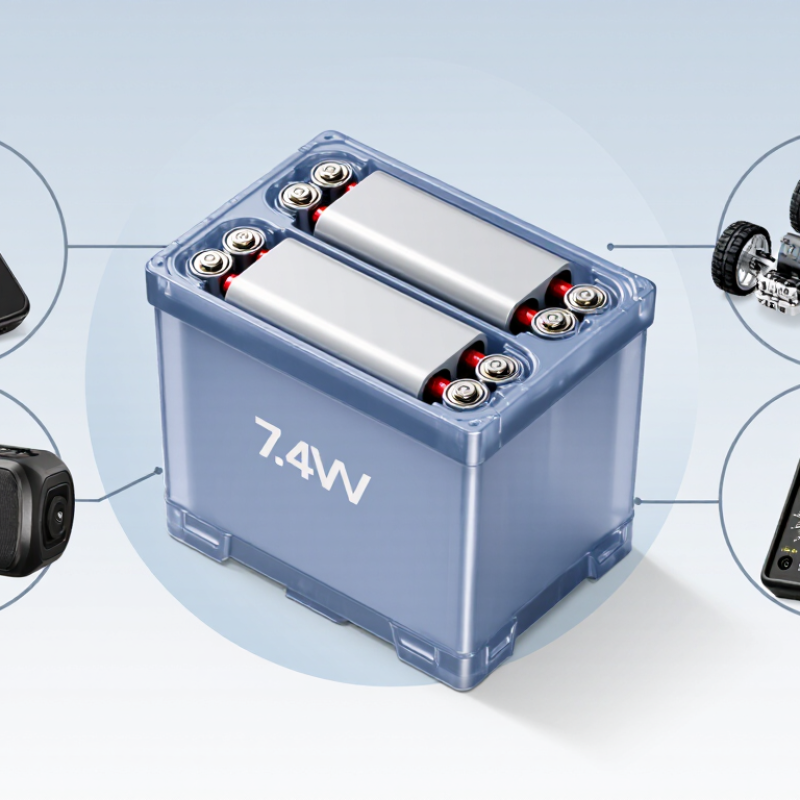
A 7.4V lithium-ion battery pack usually connects two cells in series. Each cell has a nominal voltage near 3.7V, so their voltages add together. When fully charged, a common two-cell pack reaches about 8.4V. Not 7.4V. That number describes nominal voltage, not a constant output. Capacity, measured in amp-hours, tells you how much charge the pack stores; voltage multiplied by amp-hours gives approximate energy in watt-hours.
Pack size and runtime depend on more than voltage. The U.S. Department of Energy’s Alternative Fuels Data Center gives a broad lithium-ion specific-energy range of roughly 100–265 Wh/kg. Actual performance varies with cell chemistry, temperature, age, and discharge rate. A small device may run smoothly on a 7.4V pack, yet still shut down early under a sudden heavy load. The label alone can feel reassuring. It is not the whole story.
Tips: Check that the device accepts the pack’s full-charge voltage, not just its nominal rating. Confirm connector polarity, capacity, and the manufacturer’s charging limits. Leave room for a safety margin. One detail is easy to miss: a higher-capacity pack may be larger or heavier, and runtime estimates are only estimates.
How Its Two-Cell Configuration Produces 7.4V
A 7.4V lithium-ion pack usually contains two cells connected in series.
Each cell contributes its voltage, while the pack’s amp-hour capacity stays roughly the same. The arithmetic is simple:
3.7V plus 3.7V equals 7.4V.
That is a nominal rating, not a constant reading. IEC 61960-3:2017 treats rated voltage as a declared cell characteristic; actual values vary with chemistry and design. At rest, a charged two-cell pack may read close to 8.4V when each cell’s upper charge limit is 4.2V.
Check the cell specification.
Series wiring raises voltage. It does not double capacity.
In practical terms, a small device designed for 7.4V can use a two-cell pack to deliver more voltage than one cell, without requiring a larger cell. But a mismatched charger or weak cell can make the pack unsafe or shorten its life. This detail matters at scale: the IEA’s Global EV Outlook 2024 reports that
electric-car battery demand exceeded 750 GWh in 2023,
illustrating how cell-level design underpins larger battery systems. That figure is not a direct measure of 7.4V packs, of course. And the label alone tells you little about runtime; capacity, load, temperature, and aging matter too.
A little nuance helps.
Advantages for Compatible Devices
Why Choose a 7.4V Lithium Ion Battery Pack?
Advantages for Compatible Devices
A 7.4V lithium-ion battery pack typically uses two cells connected in series. It suits devices designed for that voltage, such as some portable electronics, testing equipment, and small cordless tools. The right pack can provide steady power without requiring a bulky battery arrangement. But voltage alone does not confirm compatibility.
Check the device’s manual or original battery label before choosing a replacement. Match the rated voltage, connector shape, polarity, and physical dimensions. Capacity, measured in amp-hours or milliamp-hours, affects runtime, but a larger capacity pack may not fit the compartment. Small details matter. A connector that looks right can still have different wiring.
Charging requirements deserve equal attention. Use a charger specified for the battery chemistry and pack configuration; a 7.4V label does not describe every charging detail. Also confirm that the device supports the pack’s protection features and discharge limits. This is easy to overlook when comparing listings. In practice, fit and runtime can vary, so check the device specifications rather than relying on appearance or voltage alone.
Common Applications and Selection Factors
A 7.4V lithium-ion pack commonly has two cells connected in series. Its nominal voltage is 7.4V, but the charging voltage depends on the cells and pack design. These packs appear in portable monitors, camera equipment, handheld instruments, and small mobile robots. Their moderate voltage suits devices that need more power than a single-cell pack can provide.
Match the pack to the device’s voltage range and peak current, not just its capacity. A motor may draw a brief surge when starting. The pack’s protection circuit must handle that demand. Check dimensions, connector type, and polarity before ordering; a plug that looks right may still be wired differently. More capacity is not always better. A larger pack can add weight or fail to fit its enclosure.
Confirm that the charger is designed for the pack’s cell chemistry and charge limits. Check its operating temperature range, too, especially for outdoor equipment. Cold weather can reduce available capacity, while heat can shorten service life. A datasheet is useful, but real device testing matters. It is easy to overlook idle drain or sudden load changes. Small details matter. A pack that works on a workbench may behave differently inside a tightly enclosed device.
Why Choose a 7.4V Lithium-Ion Battery Pack?
Compare typical series-pack voltages to see where a 2-cell (2S) pack fits.
A 2S pack is commonly rated at 7.2–7.4V nominal and reaches 8.4V when fully charged (4.2V per cell). It can suit portable equipment such as handheld scanners, small robotics, or lighting when the device is designed for a 2S pack. Before choosing one, verify the device’s voltage range, required capacity and discharge current, charger compatibility, protection circuitry, and connector.