留下你的信息

What Is a 48V Lithium Battery for an Electric Bike?

A 48V Lithium Battery For Electric Bike is more than a number printed on a casing. It describes the battery’s nominal voltage, which must match the bike’s electrical system. Capacity matters too. A 48V, 10Ah pack stores about 480 watt-hours, while a 15Ah pack stores about 720 watt-hours. That difference can affect ride duration, but it does not guarantee a specific distance. Rider weight, hills, temperature, tire pressure, and assist level all change the result. Real roads are rarely laboratory conditions.

Ed Benjamin, founder of the Light Electric Vehicle Association, is an established voice in the electric-bike industry. A useful editorial takeaway is: “Voltage is only one part of a battery’s story.” This is a summary, not a verified verbatim quotation from Benjamin. It points to what buyers should check: battery capacity, compatible charger, battery-management system, connector, and the manufacturer’s specifications. Look at the label, not just the seller’s headline. A mismatch can cause performance problems or damage equipment. Small details matter.

This guide explains what 48 volts means, how watt-hours relate to stored energy, and what to compare before choosing a battery. It also separates practical expectations from marketing claims. Range estimates can be optimistic. Your commute may include a steep climb, a cold morning, or a long stretch of headwind. Those details count. A careful match between battery and bike is more useful than choosing the biggest number on the page.
What Is a 48V Lithium Battery for an Electric Bike?

Definition and Basic Role of a 48V E-Bike Lithium Battery

A 48V lithium battery for an electric bike is a rechargeable pack with a nominal voltage of 48 volts. It stores energy and supplies it to the bike’s electrical system. The controller manages that power, while the motor turns it into assistance at the wheel. In practice, the battery’s voltage changes as it charges and discharges; 48V does not mean a constant reading. A fully charged pack may show a higher voltage. That detail is easy to overlook.

Tip: Check the bike’s manual for compatible voltage and connectors. Keep the battery dry, secure, and away from extreme heat. Don’t judge riding range by voltage alone.

Capacity matters, too. It is commonly listed in amp-hours (Ah) or watt-hours (Wh), and helps indicate how much energy the pack can hold. A larger capacity may support longer rides, but terrain, rider weight, speed, temperature, and assist level also affect range. A short, steep hill can use energy faster than a flat path. So the label gives useful clues, not a precise distance promise. Charging with the specified charger and checking the case for damage are practical habits. If the pack becomes unusually hot, swollen, or damaged, stop using it and seek qualified service. I would not assume every 48V pack fits every e-bike.

How Voltage and Battery Capacity Are Measured

What Is a 48V Lithium Battery for an Electric Bike?
How Voltage and Battery Capacity Are Measured

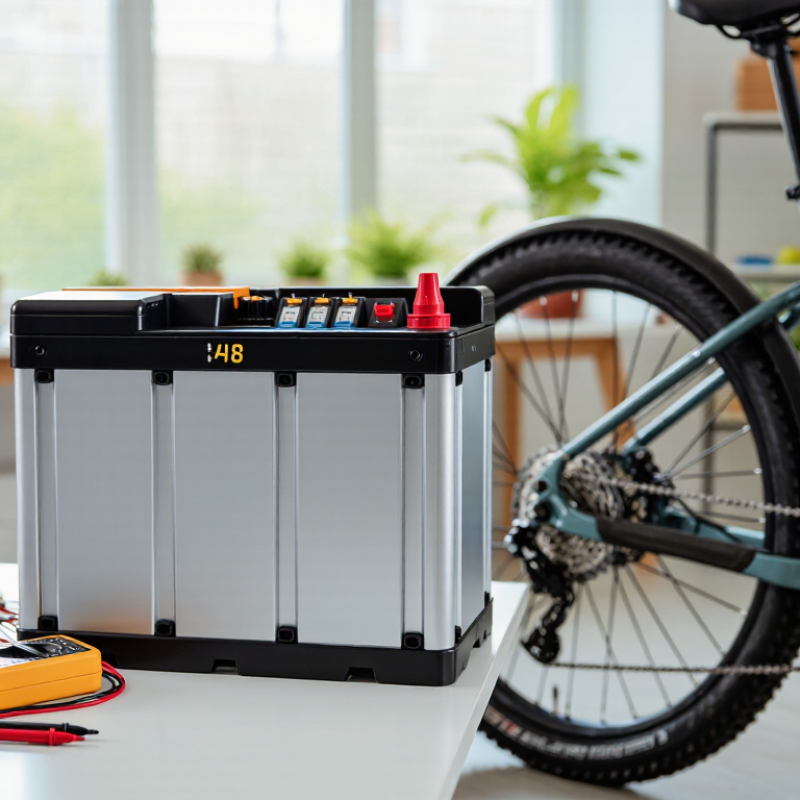
A 48V lithium battery is a battery pack designed around a nominal voltage of 48 volts. Voltage describes the electrical pressure that helps move current through the motor system. It is not a fixed reading: a fully charged pack usually measures higher than 48 volts, and its reading falls as energy is used. The exact values depend on the pack’s cell arrangement and chemistry. Check the battery label or technical manual rather than guessing from “48V” alone.

Capacity is commonly listed in amp-hours (Ah), which indicates how much charge a battery can supply over time. For a rough energy estimate, multiply voltage by amp-hours: a 48V, 15Ah pack is about 720 watt-hours (Wh). That figure helps compare stored energy, but it does not promise a specific riding distance. Hills, rider weight, temperature, tire pressure, and assist level all affect range. Small details matter. Even the display’s remaining bars can be imprecise.

Tips: Compare batteries using watt-hours when possible, and confirm the voltage and connector match your bike. Use a meter only if you know how to measure safely; never let its probes touch each other across battery terminals. I’d also treat capacity estimates as a starting point, not a guarantee. Real rides rarely follow neat calculations.

What Is a 48V Lithium Battery for an Electric Bike? - How Voltage and Battery Capacity Are Measured

Measurement or specification What it means Typical example for a 48V-class battery
Nominal voltage The approximate operating voltage used to describe a battery system. It is a rated value, not a constant reading at every state of charge. Many 48V-class lithium-ion e-bike batteries use 13 cell groups in series and are rated at about 46.8–48.1V, depending on the cells and rating convention.
Fully charged voltage The voltage near the top of the charge range. It depends on the cell chemistry and the battery’s series configuration. A common 13-series lithium-ion pack reaches 54.6V when fully charged, based on 4.2V per cell group.
Voltage measurement Measured in volts (V) across the battery terminals with a suitable voltmeter. The reading changes with charge level, load, temperature, and battery condition. A reading below the fully charged voltage is normal during use. Voltage can briefly dip when the motor draws current.
Capacity Measured in amp-hours (Ah). It describes how much electric charge a battery can deliver under specified test conditions; it does not indicate voltage. A battery labeled 14Ah is rated to deliver 14 amp-hours under its stated testing conditions.
Energy Measured in watt-hours (Wh). A useful approximate calculation is nominal voltage multiplied by amp-hour capacity. At 48V nominal, 10Ah is about 480Wh; 14Ah is about 672Wh; and 17.5Ah is about 840Wh.
Capacity measurement Typically determined by charging the battery, then discharging it at a specified current and measuring delivered charge in Ah or energy in Wh. Actual results can vary with discharge rate, temperature, battery age, and the test equipment and cutoff settings.
Remaining charge and usable range Voltage and capacity help describe a battery, but neither gives a guaranteed riding distance. Range also depends on rider and cargo weight, terrain, speed, assist level, tires, and weather. Two batteries with the same nominal voltage can provide different energy and range if their Ah ratings differ.

Note: “48V” describes a voltage class. Check the battery and e-bike manufacturer’s specifications for compatible voltage, charger requirements, chemistry, and operating limits.

Main Components and How the Battery Delivers Power

A 48V e-bike battery is a group of lithium-ion cells, not one oversized cell. Cells are joined in series to raise voltage, then in parallel to increase capacity and current. The pack also contains a battery management system (BMS), temperature sensors, wiring, and protective housing. The BMS monitors cell voltage and temperature, and can limit power when conditions become unsafe. Small circuit. Important job.

When you pedal or use the throttle, the controller draws direct current from the pack and sends it to the motor. Electrical power is approximately voltage multiplied by current: at 48 volts and 15 amps, that is about 720 watts. Actual output varies with charge level, temperature, and controller limits. A wiring diagram makes the layout look neat; real packs are less tidy, and damaged connections can create heat.

Battery quality also depends on cell matching and pack design, not voltage alone. BloombergNEF’s 2024 lithium-ion battery price survey reported an average pack price of $115 per kilowatt-hour, 20% lower than in 2023. That figure covers the wider battery market, not e-bike packs specifically, but it shows why cell sourcing and assembly matter. Ask for the pack’s watt-hours, current rating, and BMS protections; “48V” by itself tells you little about riding range.

What Is a 48V Lithium Battery for an Electric Bike?

Illustrative electrical power delivered at different battery current levels

A lithium battery pack supplies DC power to the motor controller, which regulates power to the motor. The cells store energy, while the battery management system monitors and protects the pack. At a nominal 48 V, electrical power is calculated as voltage × current: for example, 10 A corresponds to 480 W. Actual voltage varies with charge level, and available current depends on the pack and its protection system.

Compatibility with E-Bike Motors, Controllers, and Chargers

A 48V lithium battery is rated at 48 volts nominally, but its output changes as it charges and discharges. A common 13-cell-series pack reaches about 54.6 volts when fully charged. That difference matters: the motor and controller must tolerate the pack’s maximum voltage, not just its label. Check the controller’s input range and current limit, then confirm that the motor is intended for that system. A motor may physically connect yet still run poorly or overheat if the controller demands more current than it can handle. Small detail, big consequences.

Connectors, polarity, and battery-management-system limits also affect compatibility. Never assume two matching plugs have the same wiring. For charging, use a charger made for the battery’s chemistry and exact full-charge voltage; a typical 13-series lithium-ion pack uses a 54.6V charger, but not every 48V pack has the same configuration. Check the battery label or documentation. Charging current should also stay within the pack’s stated limit. A charger that fits is not necessarily the right charger. These checks can feel fussy, and specifications are sometimes incomplete, so pause before connecting anything. When details conflict, ask a qualified service professional rather than guessing.

Factors That Affect Range, Lifespan, and Safe Use

What Is a 48V Lithium Battery for an Electric Bike?

Factors That Affect Range, Lifespan, and Safe Use

A 48V label describes voltage, not how far the bike will travel. Multiply voltage by amp-hours to estimate stored energy: a 48V, 15Ah pack holds about 720Wh. At an illustrative 12–20Wh per mile, that equals roughly 36–60 miles. That estimate is not a promise. Hills, rider weight, tire pressure, cold weather, and heavy motor assist can shrink it quickly.

Battery life depends on how it is charged, stored, and used. National Renewable Energy Laboratory battery-aging research identifies temperature and time spent at a high charge level as factors that accelerate lithium-ion degradation. Avoid leaving a pack in a hot car or storing it empty for months. Small details matter. I would check the manual for the recommended storage charge; guessing is easy, but not ideal.

Safe use starts with a charger made for the pack’s exact voltage and chemistry. Inspect the case and cable before charging, and stop using a battery that is swollen, unusually hot, or damaged. UL 2849 covers electrical systems for e-bikes, while UL 2271 addresses light electric vehicle batteries. These standards provide useful safety benchmarks, but a certification mark does not excuse careless charging or damaged equipment.