留下你的信息

How to Choose the Best Waterproof Battery in 2026?

Choosing the best Waterproof Battery in 2026 requires more than reading a product label. Water resistance affects safety, service life, charging reliability, and equipment performance. A battery used on a fishing boat faces different demands than one installed on an outdoor security camera. Salt spray, vibration, freezing mornings, and repeated charging can expose weaknesses quickly.

This guide examines practical factors that experienced technicians and careful buyers should verify. We will compare battery chemistry, capacity, voltage stability, operating temperature, charging speed, and expected cycle life. We will also explain IP ratings, sealed housing design, connector protection, and manufacturer testing evidence. An IP rating matters, but it does not guarantee unlimited underwater use. That distinction is easy to miss.

Real details matter.

Look for reinforced terminals, tight gaskets, corrosion-resistant materials, and clear charging instructions. A reliable manufacturer should publish test conditions, warranty terms, and maintenance requirements. Independent certifications can strengthen confidence, although certification marks still deserve verification. Marketing language alone is not proof.

The right battery depends on the environment, load, installation position, and replacement budget. A large capacity may seem attractive, yet extra weight or slow charging can create practical problems. Some lithium models perform well in cold conditions, but their charging limits require attention. No selection method is perfect. Product specifications may be incomplete, and laboratory results may not represent years of outdoor exposure.

That uncertainty deserves honesty. By weighing evidence, user experience, and realistic operating conditions, buyers can make a safer and more informed decision in 2026.
How to Choose the Best Waterproof Battery in 2026?

Define Your Waterproof Battery Requirements and Use Case

Choosing the best waterproof battery in 2026 starts with a precise use case, not a product label. Define where the battery will operate, how long it must run, and what loads it will power. A kayak sensor needs different protection than an outdoor camera or an emergency lighting system. Record the voltage, peak current, daily operating hours, and charging method. Small details matter.

Waterproof does not mean permanently safe underwater. Check the certified IP rating, immersion depth, test duration, and operating temperature. Also inspect the charging port, cable seals, mounting points, and enclosure materials. Saltwater, mud, vibration, and condensation can create failures even when the casing looks strong. In practical testing, battery capacity should be checked under the real load, not only under laboratory conditions. Allow extra capacity for cold weather and aging. The perfect estimate is rarely perfect.

Tips: Measure twice. Test the complete setup before installation. Look for a datasheet with capacity, discharge limits, charging conditions, and safety protections. If the battery will sit outside for months, choose a design with corrosion-resistant terminals and a replaceable seal when possible. Avoid relying on appearance alone. A thick case may still hide a weak connector. Also question your first assumption; the smallest battery may be convenient, but its limited reserve could cause repeated shutdowns.
Compare Waterproof Ratings, Battery Chemistries, and Safety Standards

How to Choose the Best Waterproof Battery in 2026?

A waterproof battery needs more than a sealed plastic case. Check its IP rating under IEC 60529. IP67 means dust protection and temporary immersion up to one metre, usually for 30 minutes. IP68 allows deeper or longer immersion, but the manufacturer must define the test conditions. Those conditions matter. A pack tested in fresh water may perform differently in salt spray, mud, or freezing rain. Inspect the gasket, cable glands, and charging port. Small cracks can defeat impressive specifications.

Chemistry affects safety, weight, and service life. Lithium iron phosphate cells generally offer strong thermal stability and long cycle life. Other lithium-ion chemistries can provide higher energy density, but they demand tighter temperature and charging controls. Lead-acid batteries remain practical for stationary equipment, although they are heavier and need ventilation.

The International Energy Agency reported that battery demand in the energy sector exceeded 750 GWh in 2023, rising about 40% from the previous year. Growth increases choice, but not necessarily quality.

Look for compliance with IEC 62133-2 for portable lithium cells and packs, plus UN 38.3 transport testing. A credible supplier should provide test reports, protection-circuit details, and clear charging limits. Do not trust “waterproof” alone. IP testing uses new, controlled samples. Real batteries face vibration, worn seals, and condensation. I have seen moisture enter through a cable opening, not the battery shell. That detail is easy to miss. Temperature sensors and overcharge protection are essential. Some specifications still feel incomplete.

Calculate Capacity, Runtime, and Charging Requirements

How to Choose the Best Waterproof Battery in 2026?
Calculate Capacity, Runtime, and Charging Requirements

Choosing a waterproof battery starts with the load, not the enclosure. Write down each device’s voltage and power demand. A 12-volt device drawing 5 amps uses about 60 watts. For an eight-hour runtime, it needs roughly 480 watt-hours. Add a safety margin of 20 to 30 percent. Cold weather, aging cells, and cable losses reduce usable energy. Real conditions are messier.

Convert amp-hours into watt-hours with this formula: Wh = V × Ah A 12-volt, 100Ah battery stores about 1,200Wh under ideal conditions. Usable capacity may be lower, especially with lithium protection limits or high discharge rates. Divide required watt-hours by usable watt-hours to estimate runtime. Check the battery’s continuous output rating, too. Capacity alone does not prove suitability.

Charging needs equal attention. A 600Wh battery with a 120-watt charger may require more than five hours. Charging losses can extend that time. Confirm the charger matches the battery chemistry, voltage, and connector. Do not charge a wet battery unless its instructions allow it. An IP rating also has limits; water resistance is not automatic permission for permanent submersion. My first estimate would often look too optimistic without measuring actual device consumption. A small power meter can reveal the difference.

Evaluate Size, Durability, Temperature, and Installation Constraints

How to Choose the Best Waterproof Battery in 2026?

A suitable waterproof battery begins with its physical size. Measure the compartment, cable path, and clearance around terminals. A battery that barely fits may become difficult to inspect or remove. Check its usable capacity, not only its advertised capacity. In field installations, extra space often prevents damaged connectors and trapped moisture. I once underestimated cable bend space; the battery worked, but maintenance became unnecessarily awkward.

Durability depends on more than a sealed case. Look for strong housing, protected terminals, vibration resistance, and a clear water-resistance rating. Waterproof does not mean permanently submersible. Salt spray, mud, and repeated temperature changes can weaken seals over time. Temperature performance also matters. Cold conditions may reduce available power, while high heat can shorten service life. Review operating and storage temperature limits carefully. Specifications are useful, but real installation conditions can be less forgiving.

Tips: Match the battery to its installation environment. Leave room for ventilation, inspection, and safe cable movement. Secure the unit against vibration without crushing its enclosure. Use corrosion-resistant connectors where moisture is expected. Test voltage and charging behavior after installation. Do not rely on one quick test. A battery can appear healthy while struggling under load. Recheck it after a cold night or a hot operating cycle. My own preference is conservative sizing, although it can increase cost and weight. That trade-off deserves honest review.

How to Choose the Best Waterproof Battery in 2026?

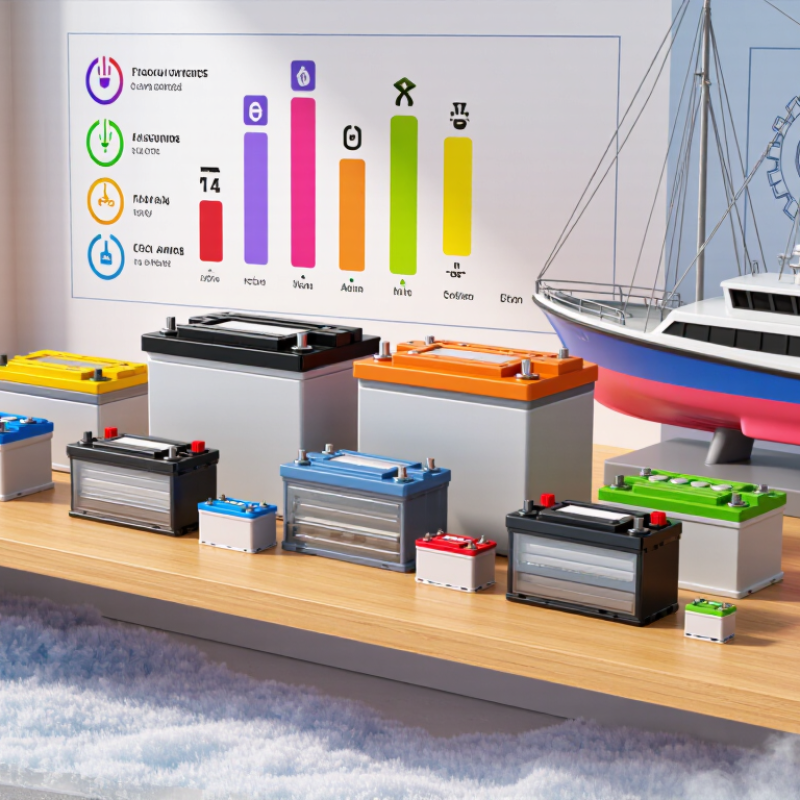
A comparative screening index for common 12 V battery configurations, evaluating size, durability, temperature capability, and installation constraints.

The 0–10 scores are representative engineering-screening values derived from typical non-brand specifications. LiFePO4 batteries commonly provide approximately 2,000–5,000 cycles at moderate depth of discharge, while AGM batteries commonly provide approximately 300–800 cycles. Typical charging limits are about 0–45°C for LiFePO4 and about −15–50°C for AGM, but the exact limits depend on the battery design and battery-management system.

For waterproof installation, verify the complete enclosure rating rather than assuming the battery chemistry is waterproof. Under IEC 60529, IP67 includes temporary immersion up to 1 m for 30 minutes; IP68 requires a manufacturer-defined immersion condition beyond IP67.

Choose and Maintain the Best Waterproof Battery in 2026

Choosing the best waterproof battery in 2026 starts with matching it to your equipment. Check voltage, capacity, discharge rate, size, and connector type before comparing prices. A battery can have a sealed case yet fail under heavy rain. Look for a clear IP rating, such as IP67 or IP68. However, these ratings describe tested conditions, not unlimited underwater use. Read the manufacturer’s test details carefully.

I recommend checking the housing, gasket, and terminals before every outdoor trip. Small cracks can let moisture reach the cells. Saltwater is especially aggressive, so rinse the exterior with fresh water and dry it completely. Never charge a wet, swollen, or damaged battery. Use the correct charger, keep ventilation around the charging area, and avoid direct sunlight or freezing temperatures. These habits sound simple. They are often ignored.

For storage, keep a lithium battery partly charged, usually around 40 to 60 percent, unless its instructions state otherwise. Inspect it every few months and record unusual heat, odor, or rapid power loss. In practical use, waterproof protection is only one part of reliability; stable performance matters more. I once assumed a tight case meant complete safety, but the connector was the weak point. That mistake still influences how I evaluate batteries. Check the whole system, not just the label.

How to Choose the Best Waterproof Battery in 2026? - Choose and Maintain the Best Waterproof Battery in 2026
Battery Type Typical Nominal Voltage Common Capacity Range Waterproofing Target Expected Cycle Life Operating Temperature Best Use Cases Maintenance Requirements
Sealed Lead-Acid (SLA/AGM) 6 V or 12 V 4–200 Ah Sealed enclosure with an IP65 or higher external rating Approximately 300–800 cycles at moderate depth of discharge About −15°C to 50°C Emergency lighting, alarms, mobility equipment, backup power and small marine systems Keep terminals clean, avoid deep discharge, recharge promptly and store fully charged.
Lithium Iron Phosphate (LiFePO4) 12.8 V, 25.6 V or 51.2 V nominal packs 10–400 Ah Pack enclosure commonly rated IP65–IP67 when properly sealed Approximately 2,000–5,000 cycles, depending on temperature and discharge depth Discharge commonly about −20°C to 55°C; charging may require protection below 0°C Camping, solar storage, marine equipment, recreational vehicles and portable power systems Use a compatible battery-management system, avoid charging when frozen and follow the specified charger limits.
Lithium-Ion NMC 3.6–3.7 V per cell; higher-voltage packs are assembled from multiple cells 2–100 Ah per module Water-resistant or sealed pack designs may reach IP65–IP67 Approximately 500–1,500 cycles, depending on chemistry, temperature and charge level Typically about −20°C to 60°C; charging is generally limited near or below 0°C Compact tools, electronics, light electric vehicles and portable equipment Protect from heat, physical damage and over-discharge; use only the specified charger and protection circuit.
Nickel-Metal Hydride (NiMH) 1.2 V per cell 0.6–12 Ah per pack Requires a sealed device enclosure; battery cells themselves are not automatically waterproof Approximately 300–1,000 cycles About −20°C to 50°C, depending on the pack design Outdoor instruments, rechargeable consumer devices and low-to-moderate power applications Use a NiMH-compatible charger, prevent prolonged high-temperature storage and keep contacts dry.
Alkaline Primary Battery 1.5 V per cell Typically 1.5–18 Ah, depending on size and discharge rate Use only inside a water-resistant device; individual cells are not intended for immersion Single-use; do not recharge About −18°C to 55°C Flashlights, sensors, remote controls and emergency devices with low or intermittent power demand Remove batteries from unused devices, replace leaking cells immediately and recycle according to local rules.
Primary Lithium 1.5 V or 3.0 V per cell, depending on the cell chemistry Approximately 1.2–20 Ah Requires a sealed product enclosure; the cell is not inherently waterproof Single-use; do not recharge Often about −40°C to 60°C, subject to the cell specification Remote sensors, GPS equipment, cameras and devices exposed to cold conditions Do not recharge or short-circuit; store in a cool, dry place and follow transport and disposal requirements.
Recommended Selection Priority Match the device voltage exactly Choose enough Ah for the required runtime with a safety margin Prefer IP67 for temporary immersion; IP68 only when the manufacturer specifies immersion depth and duration Compare cycle life at the same depth of discharge Confirm both charging and discharging limits Choose according to weight, current demand, space and environmental exposure Inspect seals, connectors and cables regularly; waterproof performance depends on the complete enclosure, not only the battery chemistry.
Note: IP ratings describe protection against dust and water under defined laboratory conditions. A battery should never be immersed unless the complete battery pack and its connectors are specifically rated for that use. Capacity, cycle life and temperature figures are typical industry ranges and vary with cell design, load, charging method, storage conditions and depth of discharge.