留下你的信息

10 Tips for Buying an E Scooter Lithium Battery

Buying an E Scooter Lithium Battery is not simply a matter of choosing the largest capacity. The battery must match your scooter’s voltage, controller, charger, dimensions, and connector type. A mismatch can cause poor performance, overheating, or permanent damage. This guide introduces ten practical tips for making a safer and more informed decision.

Real-world inspection matters. Check the battery label carefully for voltage, amp-hour capacity, manufacturing date, cell information, and battery management system details. Ask the seller for test reports, warranty terms, charging instructions, and evidence of compliance with relevant safety standards. Clear product photos should show the casing, terminals, wiring, and model number. If those details are missing, pause before paying.

Do not trust impressive range claims without examining the conditions behind them. Rider weight, hills, tire pressure, temperature, and riding speed can change results significantly. A larger battery may offer longer range, but it can also add weight and require a stronger mounting system. Storage space matters too. The battery should sit firmly, without loose movement or exposed wires. Some listings look professional but provide incomplete technical data. That is a warning sign.

A qualified technician can verify compatibility before installation. Use the manufacturer’s approved charger and inspect the battery after several rides. Stop using it if you notice swelling, unusual heat, leaking, smoke, or a sharp chemical smell. These ten tips cannot remove every uncertainty, but they can reduce avoidable mistakes and help you choose reliability over attractive promises.
10 Tips for Buying an E Scooter Lithium Battery

Understanding E-Scooter Lithium Battery Types and Specifications

Buying an e-scooter lithium battery starts with chemistry, not price. Most packs use lithium-ion cells, including NMC or LFP varieties. NMC usually offers higher energy density and lighter weight. LFP often provides stronger thermal stability and longer service life. Each choice affects range, weight, charging time, and cost.

I used to compare only amp-hours. That was a mistake. Voltage must match the scooter’s electrical system, while amp-hours indicate capacity at that voltage. Watt-hours give a clearer range estimate: multiply nominal volts by amp-hours. A 36V, 10Ah pack stores about 360Wh. Real range varies with rider weight, hills, tire pressure, temperature, and riding speed. Check the battery management system, or BMS, for overcharge, over-discharge, overcurrent, and temperature protection.

Physical specifications matter just as much. Measure the battery compartment carefully, including cable space and mounting points. Confirm the connector type and polarity before purchase. Never force a connector. Look for clear testing records, cell information, and a stated cycle-life method. Cycle claims can be misleading because laboratory conditions differ from daily riding. I have seen a smaller pack perform better because its BMS was properly matched to the motor. Avoid swollen, cracked, wet, or unusually hot batteries. Store the pack in a cool, dry place, and use the charger specified for its voltage and chemistry. A qualified technician should inspect uncertain wiring or damaged cells.

Typical E-Scooter Battery Pack Energy at 10 Ah

Battery energy is estimated as nominal voltage × capacity. For example, a 48 V, 10 Ah battery stores approximately 480 Wh. Higher-voltage packs can provide more energy at the same amp-hour rating, but actual riding range also depends on rider weight, speed, terrain, temperature, motor efficiency, and battery age.

Checking Battery Compatibility, Voltage, Capacity, and Connector Design

10 Tips for Buying an E Scooter Lithium Battery

Tip 1: Check compatibility before comparing prices. Measure the battery compartment, mounting points, and available cable length. A battery can have the correct voltage yet fail to fit securely. Check the scooter’s controller and charger specifications, not only the old battery label. During a practical inspection, I would photograph every connection before removal. Memory is unreliable.

Tip 2: Match the voltage carefully. Confirm the battery’s nominal voltage and full-charge voltage. A 36V system, for example, may charge above 40V. Never install a higher-voltage pack because it appears more powerful. It can damage the controller or create unsafe heat. Ask a qualified technician when the original information is missing. Small errors matter.

Tip 3: Compare capacity in amp-hours and watt-hours. Higher capacity usually means longer riding time, but it also adds weight and charging time. Estimate your route, rider weight, hills, and weather. Laboratory figures may not match daily use. That part deserves honest reflection.

Tip 4: Inspect the connector design closely. Match the plug shape, pin count, wire thickness, polarity, and communication pins. Similar-looking connectors can use different wiring. Do not rely on color alone. Confirm the pinout with reliable documentation or a professional meter check. A reversed connection may cause immediate damage.

Tip 5: Examine battery protection features. Look for a suitable battery management system, secure casing, balanced cells, and clear safety documentation. Avoid swollen, cracked, wet, or unusually warm packs. Keep the charger compatible with the battery chemistry. Store the battery in a dry, ventilated place, away from heat and impact.

10 Tips for Buying an E Scooter Lithium Battery - Checking Battery Compatibility, Voltage, Capacity, and Connector Design

No. Buying Check What to Verify Practical Guidance Example or Reference
1 Confirm the Battery Chemistry Check whether the replacement uses the required lithium-ion chemistry and protection system. Use a battery designed for electric scooters. Do not substitute a different chemistry unless the scooter manufacturer and charger specifications explicitly support it. Common scooter packs use rechargeable lithium-ion cells with an integrated battery management system (BMS).
2 Match the Nominal Voltage Compare the battery nominal voltage with the scooter controller and original battery label. The voltage should match exactly. A higher-voltage pack can damage the controller, motor, display, or lights; a lower-voltage pack may not operate correctly. Typical lithium-ion configurations include 24 V, 36 V, 48 V, and 52 V nominal systems. Always verify the scooter documentation.
3 Check Full-Charge Voltage Confirm that the charger output matches the battery’s required maximum charging voltage. Nominal voltage is not the same as charging voltage. Using the wrong charger can cause overheating, charging failure, or a serious safety hazard. A conventional 10-series lithium-ion pack is commonly rated at 36 V nominal and approximately 42.0 V when fully charged.
4 Choose Suitable Capacity Compare capacity in ampere-hours (Ah) and energy in watt-hours (Wh). Higher capacity generally provides longer potential range, but it may increase battery size, weight, charging time, and cost. Energy calculation: Wh = nominal voltage × Ah. A 36 V, 10 Ah pack stores approximately 360 Wh.
5 Verify Continuous Current Check the battery’s continuous discharge current and the BMS discharge rating. The battery should support the controller’s normal current demand. An undersized BMS may shut down during acceleration, hills, or heavy loads. If a controller is rated for 15 A continuous operation, the battery BMS should be rated at least for that operating requirement, subject to manufacturer guidance.
6 Measure the Battery Compartment Measure length, width, height, mounting points, and available cable clearance. Allow space for padding, wiring bends, ventilation, and secure fastening. Do not force a pack into a compartment or place it where it can be crushed. Record dimensions in millimetres and compare them with the supplier’s actual battery dimensions, not only the advertised capacity.
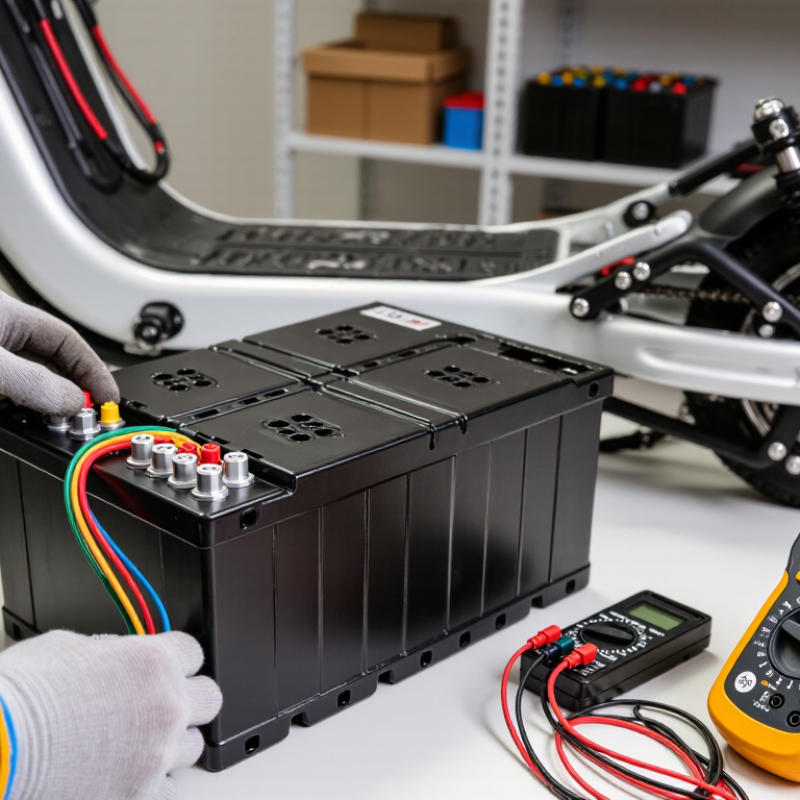
7 Match the Main Power Connector Check connector shape, pin count, polarity, wire gauge, locking method, and current rating. A connector that looks similar may have different wiring or polarity. Never rely on appearance alone; compare the wiring diagram or test with suitable equipment. Positive and negative terminals must correspond correctly. A reversed connection can damage electronics and create a short-circuit risk.
8 Check Charge-Port Compatibility Inspect the charging connector, centre polarity, charge current, and whether a separate charging lead is required. The charge port and charger must be compatible with the battery BMS. Do not use a charger solely because the plug physically fits. Barrel-style connectors can have different dimensions and polarity arrangements, so both electrical specifications and plug size must be checked.
9 Review BMS Protection Features Confirm protection against overcharge, over-discharge, overcurrent, short circuit, and excessive temperature. A BMS helps manage cell safety and balance, but it does not make an unsuitable installation safe. The battery must still be correctly mounted and wired. Look for documented protection thresholds, balancing capability, and temperature monitoring rather than an unspecified “smart protection” claim.
10 Assess Safety and Documentation Request specifications for cells, capacity, voltage, BMS rating, charger requirements, dimensions, and operating conditions. Prefer a pack with clear electrical data, secure insulation, protected terminals, and suitable transport documentation. Stop using any pack that is swollen, leaking, physically damaged, or unusually hot. Store and charge the battery in a dry, ventilated area away from flammable materials, and follow the supplied charging and disposal instructions.

Note: Battery voltage, charger output, current rating, connector wiring, and physical dimensions must be verified against the scooter’s original specifications before installation.

Evaluating Battery Safety Features, Quality, and Certification

10 Tips for Buying an E Scooter Lithium Battery

Evaluating Battery Safety Features, Quality, and Certification

A reliable e-scooter lithium battery should include a battery management system (BMS). It should control overcharging, deep discharge, excessive current, and abnormal temperature. Check whether the BMS protects every cell group, not only the complete battery pack. A secure enclosure matters too. Look for firm connectors, insulated terminals, sealed joints, and wiring without crushed sections. During inspection, reject batteries with swelling, unusual odor, corrosion, or heat after light use. Small details matter.

Quality depends on the cells, assembly process, and traceability. Ask for the cell type, production date, capacity test results, and batch identification. A clear test report is more useful than a vague safety logo. Certification should match the exact battery model, not a similar product. Depending on the market, relevant evidence may include IEC 62133-2 testing, UN 38.3 transport testing, or applicable regional requirements. Verify the certificate number and issuing laboratory when possible. Be careful.

A polished label can still hide poor assembly. That is an uncomfortable point. If the seller avoids technical questions, pause before buying. Also check charging compatibility, because the wrong voltage can create serious heat. Never judge quality by capacity alone. A battery with slightly lower capacity may be safer when its cells, BMS, and enclosure are properly matched. Keep records of the invoice and test documents. They can support a warranty claim or safety investigation later.

Comparing Battery Range, Lifespan, Charging Time, and Performance

10 Tips for Buying an E Scooter Lithium Battery

Range should be measured in watt-hours, not marketing promises. Battery capacity equals voltage multiplied by amp-hours. A 36V, 10Ah pack stores about 360Wh before riding losses. Real range falls with rider weight, hills, cold weather, tire pressure, and frequent acceleration. Independent testing remains inconsistent, because no universal scooter-range procedure covers every market. Treat advertised distance as an optimistic ceiling. The European Environment Agency also identifies temperature, vehicle load, and usage patterns as major efficiency factors.

Lifespan depends on cycles, heat, storage level, and charging habits. The U.S. Department of Energy reports that lithium-ion durability varies substantially with operating conditions. A quality pack may deliver several hundred full cycles, but that is not guaranteed. Ask for cycle-life test conditions, not just a cycle number. Battery management software should limit overcharging, overheating, and deep discharge. Small detail. It matters.

Charging time can be estimated by dividing battery watt-hours by charger output, then adding roughly 10–20% for charging losses. A 360Wh battery with a 100W charger may need about four hours, not 3.6. Faster charging saves time but can increase heat and long-term stress. BloombergNEF reported an average lithium-ion pack price of 115 dollars per kWh in 2024, yet a lower price does not prove better performance. Check cell documentation, warranty terms, replacement availability, and independent safety certification. My own buying mistake would be trusting range before checking cold-weather performance. That habit deserves reconsideration.

Selecting a Reliable Seller and Reviewing Warranty and After-Sales Support

10 Tips for Buying an E Scooter Lithium Battery

When buying an e-scooter lithium battery, the seller matters as much as capacity. Choose a business that publishes cell chemistry, rated voltage, usable capacity, dimensions, and connector details. Vague listings create expensive mistakes. Ask for a dated invoice, batch information, and clear installation guidance before payment. A reliable seller should explain compatibility, storage temperature, charging limits, and safe disposal procedures. Look for traceable quality records, not impressive promises. Independent reviews can help, but inspect repeated complaints about swelling, late shipping, or unanswered messages. One criticism deserves attention. I would also contact support with a technical question. A useful reply should be specific, patient, and written by someone who understands battery protection systems.

Read the warranty before judging the price. Check its duration, covered defects, capacity threshold, and proof required for a claim. Check the details. Some policies cover manufacturing faults but exclude water damage, incorrect chargers, physical impact, or unauthorized modification. Ask who pays return shipping and whether testing is required before replacement. After-sales support should provide a reachable email, response timeframe, troubleshooting steps, and a safe return process. Keep photos of the package, connectors, and installation date. Keep records. A seller may advertise two-year coverage yet respond slowly when the battery fails. That gap matters more than a glossy product page. I prefer written answers over phone assurances, although this is not foolproof. If terms remain unclear, delay the purchase. A slightly higher price can be reasonable when support is documented and accessible. Still, no warranty replaces correct charging, regular inspection, and immediate action after unusual heat or odor.