What Are the Top Types of Li Ion Polymer Batteries?
A Li Ion Polymer Battery is often recognized by its thin, flexible pouch, but the pouch alone does not define its performance. The term commonly describes lithium-ion cells using polymer-based or gel-like electrolyte systems and pouch packaging. Inside, different electrode chemistries create very different trade-offs. That distinction matters.
Battery scientist Shirley Meng has emphasized a practical principle: chemistry choices must fit the application, rather than simply maximize energy density. This overview uses that lens to compare common types, including lithium cobalt oxide (LCO), nickel manganese cobalt (NMC), lithium iron phosphate (LFP), and lithium manganese oxide (LMO). Each has a different balance of capacity, power delivery, lifespan, cost, and thermal behavior. A compact LCO pouch cell may suit a slim device, while an LFP design may prioritize cycle life and stability in other applications. NMC often balances energy and power, though its exact performance depends on formulation and cell design.
The labels are useful, but not perfectly tidy. “Polymer” does not identify one cathode chemistry, and two cells with the same chemistry can still differ in electrode thickness, protection circuitry, and manufacturing quality. We will also examine high-capacity and high-rate variants, explain how to read specifications, and identify details worth checking, such as rated voltage, cycle-life test conditions, and temperature limits. A printed capacity number is only part of the story. Real performance depends on the device, operating conditions, and reliable testing. The comparisons ahead aim to make those differences clear without treating any one type as universally best.
Li-Ion Polymer Describes a Cell Format, Not a Single Cathode Chemistry
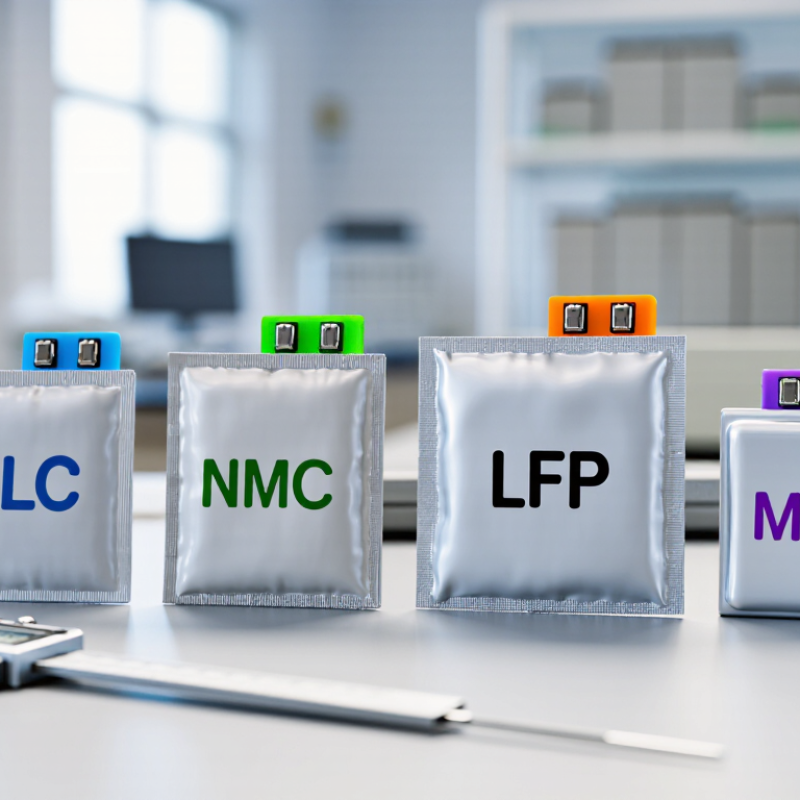
“Li-ion polymer” describes a cell format, not one specific cathode chemistry. Many cells use a flexible pouch, which can reduce weight and fit slim devices. The electrolyte and cell construction may differ, too. The label can be confusing.
Common cathode types include lithium cobalt oxide (LCO), nickel manganese cobalt oxide (NMC), and lithium iron phosphate (LFP).
LCO is often chosen for compact electronics because it offers high energy density.
NMC balances energy, power, and service life, though its performance depends on the exact formulation and cell design.
LFP generally offers strong cycle life and thermal stability, but often stores less energy in the same volume.
These are trade-offs, not simple rankings.
For a real application, compare the cell’s datasheet, not just the words “polymer” or “pouch.” Check rated capacity, discharge limits, operating temperature, and cycle-life test conditions.
A thin pouch cell may fit neatly beneath a device cover, yet still need careful mechanical protection.
Small detail.
The cathode chemistry helps explain performance, but it cannot predict every cell’s behavior by itself. Construction and quality control matter, too.
LCO Polymer Cells: About 3.7 V Nominal and 150–200 Wh/kg
LCO polymer cells use lithium cobalt oxide as the cathode material. Their nominal voltage is about 3.7 V per cell, though voltage changes during charging and discharging. A fully charged cell operates above its nominal voltage, so equipment must follow the cell’s specified voltage limits. That matters. Typical specific energy is often quoted around 150–200 Wh/kg, but the exact figure depends on cell design and test conditions.
The pouch format can fit thin devices where a rigid metal cylinder would be awkward. Picture a flat cell tucked behind a screen: it saves space, but its flexible casing needs protection from punctures and excessive pressure. The stated energy-density range usually describes the cell, not a complete battery pack with wiring, casing, and controls. Real-world figures can therefore be lower. Not always obvious.
LCO chemistry is valued for its relatively high energy storage in a compact mass, but it is not ideal for every duty cycle. Heat, charging rate, operating temperature, and depth of discharge can affect service life. For a specific application, check the manufacturer’s datasheet for capacity, maximum charge voltage, discharge limits, and cycle-life test conditions. Two cells with the same nominal voltage may behave differently; the headline number alone is not enough.
NMC Polymer Cells: About 3.6–3.7 V Nominal and 150–250 Wh/kg
NMC polymer cells use a nickel-manganese-cobalt oxide cathode in a lightweight pouch-style format. Their nominal voltage is typically about 3.6–3.7 V, though the exact figure depends on the cell design. The quoted energy-density range, around 150–250 Wh/kg, is a broad guide rather than a guarantee. Useful, but not magic. A compact cell near the upper end can reduce battery weight, yet packaging, protection circuits, and operating conditions affect the finished product’s performance.
In practice, check the manufacturer’s cell-level specifications and test conditions before comparing figures. A small pouch cell may fit neatly beneath a device’s enclosure, but its usable capacity can differ from a headline rating. Temperature, charge rate, and aging also matter. Higher energy density can be appealing, but it does not alone determine service life or suitability. This is easy to overlook. For a fair comparison, look at voltage, capacity, dimensions, mass, and discharge limits together. And leave room for uncertainty: published ranges simplify real-world trade-offs.
LFP Polymer Cells: About 3.2 V Nominal and 90–160 Wh/kg
LFP polymer cells use lithium iron phosphate chemistry in a flexible pouch format. Their nominal voltage is about 3.2 V, while practical gravimetric energy density often falls around 90–160 Wh/kg. The spread reflects electrode design, packaging, and test conditions; it is not a guaranteed cell specification. A cell near the lower end may suit stationary storage, while lighter designs can help reduce pack mass. Still, lighter does not automatically mean better.
The International Energy Agency’s Global EV Outlook 2024 reports that LFP made up nearly 40% of global electric-car battery sales in 2023. That adoption reflects cost and durability advantages, alongside lower energy density than some nickel-rich chemistries. For a real comparison, check the manufacturer’s datasheet for usable capacity, discharge limits, and cycle-life test conditions. I would treat the 90–160 Wh/kg range as a screening guide, not a design promise. Small differences in test method matter.
Tips: Check voltage under load, not only the nominal figure. Compare complete-cell mass, including pouch and tabs, and leave room for thermal management. Even a neat spreadsheet can miss that detail.
What Are the Top Types of Li Ion Polymer Batteries? - LFP Polymer Cells: About 3.2 V Nominal and 90–160 Wh/kg
| Dimension |
Typical LFP Polymer Cell Value |
Notes |
| Cathode chemistry |
Lithium iron phosphate (LiFePO₄, or LFP) |
“Polymer” commonly refers to a pouch-format cell; the electrolyte is not necessarily a solid polymer. |
| Nominal voltage |
About 3.2 V per cell |
The exact nominal value depends on the cell specification and how it is stated. |
| Gravimetric energy density |
Approximately 90–160 Wh/kg |
A broad cell-level range; actual results vary with design, capacity, and measurement conditions. Pack-level values are lower. |
| Typical charge limit |
Usually about 3.60–3.65 V per cell |
Follow the cell maker’s specified charge voltage and charging profile. |
| Discharge cutoff voltage |
Often about 2.5–2.8 V per cell |
The permitted lower limit is product-specific; avoid discharging below the stated cutoff. |
| Cycle life |
Often in the range of 2,000–6,000+ cycles under specified test conditions |
Cycle-life claims depend on temperature, charge/discharge rate, depth of discharge, and the end-of-life criterion. |
| Thermal characteristics |
Generally strong thermal stability compared with many higher-energy lithium-ion chemistries |
LFP cells still require suitable protection, temperature control, and a battery management system. |
| Key trade-off |
Long service life and robust thermal behavior, with lower energy density than many NMC cells |
Often suited to applications that prioritize durability and safety over maximum range or minimum weight. |
Values are representative ranges, not universal limits. Check the datasheet for the specific cell before designing or operating a battery system.
NCA Polymer Cells: About 3.6 V Nominal and 200–260 Wh/kg
NCA Polymer Cells: About 3.6 V Nominal and 200–260 Wh/kg
NCA polymer cells use a nickel-cobalt-aluminum cathode and a polymer-style cell format. Their nominal voltage is commonly around 3.6 V, while reported specific energy often falls near 200–260 Wh/kg. These figures are useful comparison points, not guarantees. Actual performance depends on cell design, operating temperature, discharge rate, and ageing.
The appeal is clear: high energy in a relatively light package. That can suit compact electronics and equipment where weight matters. Still, a cell’s watt-hour rating does not tell the whole story. A device drawing heavy current may see less usable capacity, and the complete battery pack adds weight. The gap between a datasheet and daily use can be frustrating.
Tips: Check whether the stated energy applies to an individual cell or a finished pack. Compare operating limits and test conditions, too. Numbers vary. Leave room for uncertainty; I would not choose a cell based on energy density alone. Review the manufacturer’s safety guidance, and use a suitable charger and protection system.